What could mobile physio look like for you?
Every person begins with a detailed assessment, where we decide together what services would benefit you most based on your goals
Sessions can take place at your home, at the gym, the pool, or wherever suits you!
-
Your physiotherapist will complete a thorough assessment including:
1) Asking you questions to determine what your falls risks are, including:
All previous falls and circumstances
Medical conditions that make you more susceptible to falling such as Parkinsons Disease
Medications
Physical concerns such as vertigo, dizziness, lightheadedness, vision issues, numbness or altered sensation, shortness of breath, weakness/fatigue
Mobility and gait aids
Environmental factors such as stairs, lighting, footwear, personal alarms, house set up, clutter, pets
Cognitive factors such as memory loss, decision making, fear of falling
2) Complete a full balance assessment
3) Provide recommendations to
Yourself and your family if required
Your GP regarding medication/medical concerns that are contributing to falls
Your case manager if you have one, for any equipment or household changes required - for example recommending a personal alarm, or a new walking frame
4) Provide you with personalised exercises to work on your balance based on our assessment findings
5) Complete monthly or bi-monthly re-assessment of your balance to ensure things are improving
-
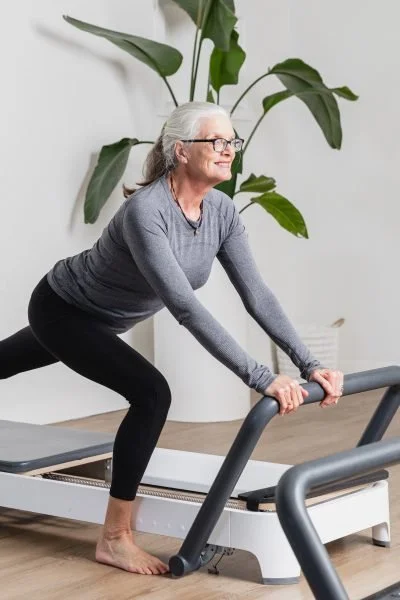
We are the only home physiotherapy providers in Melbourne that bring a portable Reformer machine directly to you for a Pilates sessions in the comfort of your own home!
Reformer Pilates is a gentle, supported form of exercise designed to improve strength, balance, and flexibility. It’s fun, low-impact, and can be tailored to suit all levels.
It’s particularly great for people that are after a bit of a challenge, or those who are wanting something fresh and new.
We also offer mat Pilates, which has similar benefits, but is completed on a mat on the floor, rather than on a Reformer machine.
** Reformer Pilates requires a longer session to account for set up time
-
Including:
Neck Pain
Shoulder Pain
Back Pain
Hip Pain
Knee Pain
-
Chronic pain can be a complicated and frustrating experience, particularly when it comes to conditions like fibromyalgia and chronic back pain.
We provide compassionate, whole person care for these conditions, and make sure you feel seen, heard and supported throughout the process.
-
We provide personalised exercise programs designed to build strength, based on your goals and our assessment findings.
These programs can either be completed under our supervision (particularly at the start of your journey), then will be printed for you to complete independently using household objects, or in the gym.
Everyone can build strength at any age, and it is the key to maintaining independence - you just need the support to get you going on the right track!
-
Hands on treatment in your own home.
Types of massage can include:
Lymphatic drainage to assist with swelling
Deep tissue massage to relieve muscle tension, stiffness and pain, and improve movement
Remedial massage for relaxation
-
Hydrotherapy is very gentle, low impact exercise in warm water, reducing the impact on your joints.
It is particularly great for people with:
Back pain
High levels of pain including back, hip, and knee pain
Conditions that affect balance and movement such as stroke
Hip and knee arthritis, or after joint replacement surgery
High body weight
** Your first hydrotherapy session requires a long session
For following sessions, if your physiotherapist is required to enter the water with you due to safety, appointments must be 1 hour to allow for changing time. If your physiotherapist is not required to enter the water and the client can enter the water independently, standard 30 minute appointment times will suffice.
If applicable, the client will need to pay for pool entry fees for themselves and the physiotherapist (usually there is a discounted rate for this) -
Your physiotherapist can meet you at your local gym to provide you with a personalised gym exercise program, ensure you are doing exercises correctly, and progress your exercises over time.
The gym can be modified for all levels, but is particularly great for those who have a reasonable level of fitness and want to maximise their strength, and those who enjoy having a ‘work out’ environment to help with motivation. Not everyone likes exercising at home!
** Your first gym session requires a long session
For following sessions, 45 minute appointment times will suffice
If applicable, the client will need to pay for gym entry fees for themselves and the physiotherapist (usually there is a discounted rate for this) -
We know how confusing, painful, and scary it can be recovering from a joint replacement.
If you are about to have a knee or hip replacement
We recommend booking in a session before your operation (preferably a few week or months prior), to get a thorough explanation of how to prepare for your operation to get the best outcome, and what to expect post-operatively. This will give you a good opportunity to take it all inOur physios are highly experienced in managing hip and knee replacements, and will guide you each step of the way - from the first steps into your house, to getting you back to gardening.
Often, people aren’t aware that having the right routines will be the difference between having a great outcome and regretting the surgery.
Treatment often involves:
Advice!
This is usually the most important part - when/how to take medications, icing, resting, walking, sleeping, compression bandages, when to get rid of your crutches, and most importantly - exercising!Gait re-training
People often have to learn how to walk normally again. After years of limping, the post operative period is the most important time to teach your body how to walk normally again - now that the arthritis pain is gone!
Your physio will analyse your gait and give you the right cues to walk straighter, and will identify which muscles are needing more work, to improve your gait.Exercises
Doing the correct exercises, at the right doses is so important in getting a good outcome. Exercises usually need to change week by week as swelling, strength, and range of motion improve, and your physio can guide you in this
Massage
Gentle massage reduces swelling, and loosen up tight muscles — which will assist in improving range of motion of the joint
Hydrotherapy
Once the wound is healed up (usually 4-6 weeks as guided by your surgeon) - hydrotherapy is one of the best ways to loosen up the leg, improve range of motion, strength, and balance. It’s also a great low impact way to get your heart rate up.
-
If you have any of these conditions, it is so important to learn how to work with your body, and not fight against it.
Your physio can educate you about your condition, and how you can improve your body and function - through exercise, advice, or hands on treatment.
Common conditions include:
Parkinsons Disease
Stroke
Multiple Sclerosis
Muscular Dystrophy or Paraparesis
Peripheral Neuropathy
Fibromyalgia and Polymyalgia Rheumatica
Arthritis
Osteroporosis
Shoulder Tendinopathies and Bursitis
Back Pain
COPD and Emphysema
Heart Failure
-
Recovering from surgery can be challenging. Our physios will help you safely rebuild strength, mobility and confidence at a pace that suits you, and helping you return to the activities that matter to you.
-
This is appropriate for people after heart or lung surgery, or those that have conditions such as COPD, emphysema, bronchiectasis, heart failure.
Our cardiac and pulmonary rehabilitation programs are designed to safely improve your endurance and confidence, and empower you to understand and work with your condition.
Sessions might include:
Gentle progressive exercise whilst monitoring vital signs if appropriate
Breathing exercises and airway clearance techniques
Education on pacing, fatigue management and managing breathlessness
Liaising with your GP, heart specialist, or respiratory specialist if required
-
We can chat with your family, OT, support coordinators, case managers or equipment suppliers to make recommendations if needed
In our assessment, we might looks at:
Assessment of falls risks and safety hazards
Assessment of stairs, steps, thresholds and uneven surface, bathroom safety
Equipment Recommendations
Assessment and recommendation of walking aids, such as walking sticks and frames
Review of shower chairs, shower stools and toilet equipment
Assessment of wheelchair or mobility equipment needs
Recommendations for exercise equipment for use at home
Education on safe and correct use of equipment